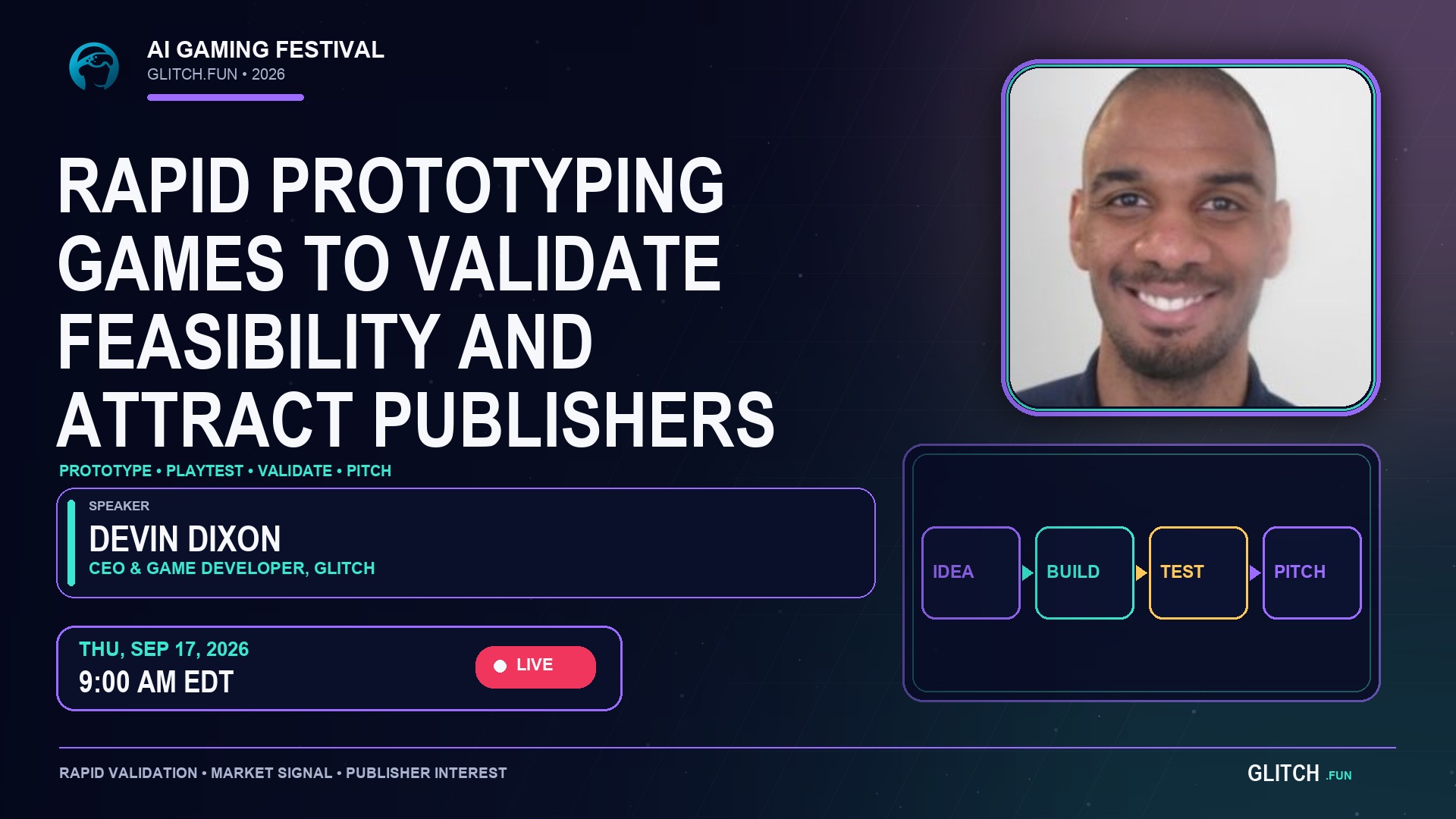
Traditionally, games took years to build, and there’s nothing more disheartening than spending a lot of time and money on a game that no one wants to play.
What if you could actually solve the viability problem of your game—“Will people want to play my game?”—within a week or two, and spend minimal time and resources before committing to it for the long haul?
In other industries, they use terms like “fail fast, fail forward,” lean startups, or market validation testing. But the underlying concept is the same: spend time and resources building something people want. Do a litmus test, and if it fails, don’t build it—or iterate on the idea.
Rapid prototyping is the ability to get a version of your game up and running quickly and test the core loop. It will involve:
- Defining what you want your core loop to be
- Building an onboarding process
- Establishing your game’s structure
- Setting up analytics
- Marketing your game and getting playtesters
- Assessing and analyzing feedback
- Deciding what to do next
By the time you follow through with these steps, you will have answers to some very important questions:
- Am I building a game that people want to play?
- Is there an audience for it?
- Who is the audience?
- How do I reach that audience?
- How can I iterate based on that feedback?
- Is this something I can pitch to publishers or investors?
Worst-case scenario, you only lose a week or two of time if the idea for your game is bad. The upside is that you can try multiple experiments until you find a game idea that resonates.
Session speakers
Learn more about the person leading this session.

Devin Dixon
SpeakerCoding since he was 12, Devin now has nearly 30 years of development experience, ranging from full-stack development and game development to successfully leading companies from 0 to 1, raising capital from top VC firms, and even teaching coding at bootcamps. On the gaming side, he has also jumped into marketing, helping games reach nearly $1 million in sales within their first year.
Choose one admission option
Tickets remain available after the event. Purchase an available ticket or pass to access the recording and learning materials when published.
Purchase-window dates are shown in your local time.
This session has ended
The recording is ready and awaiting organizer publication. It is not available to attendees until the organizer publishes it.